Friday, July 7, 2017

EXPLORING THE NIAGARA FRONTIER: The Lytle Nature Preserve


The town of Lockport is blessed with some exceptional trails. The most recent addition to that embarrassment of riches – the Lytle Nature Preserve – is far and away the least utilized.  

Maybe it’s because it’s literally sandwiched between the town’s two most popular trails, the Erie Canal towpath (a.k.a “the Canalway Trail”) and the Lockport Nature Trail.

Or, maybe it’s because it’s relatively new and, in turn, relatively unknown.

Let’s hope this column takes the trail into the known and people enjoy a jaunt on this splendid trail.

The history of the Preserve 

The 111-acre site was donated to the town in 2008 by William and Celeste Lytle. William, a retired lumberman who owned Ridegwood Lumber, had purchased the property with the intent of raising beef cattle. After scrapping that idea, the Lytles had the vision of giving the land to the town under a conservation easement through the Western New York Land Conservancy, ensuring public access to grasslands, wetlands, and forest that offer prime habitat to a variety of plants and animals.

It took a few years to go from raw land to a navigable experience for the masses.

In 2010, the town applied for Niagara Greenway funding, which it received in 2011, to make the Preserve accessible to the neighboring Canalway trail. The reasoning was that the Canalway trail had no access to natural lands despite bordering dozens of miles of prime forest and field. This would connect it to nature.

The $95,000 in Greenway money was invested in the expansion of the Canalway’s parking lot (which doubles as the Lytle Preserve’s parking), the creation of paved access and the construction of a boardwalk. Development of those various niceties began in late-2012 and continued into 2016 through efforts of Lockport highway crews and volunteers.

Getting there

The Lytle Nature Preserve is easy to get to.

If you are coming from out of town, take Route 78 north through the city of Lockport. After going through Lockport’s Lowertown section, you will pass the very popular hamburger stand, Reid’s. After doing so, you will come upon a lighted intersection (with a Crosby’s gas station at the corner). Turn right onto Old Niagara Road.

Approximately a quarter mile down that road, take your second left, which will be North Canal Road. Then, within a couple hundred feet, turn right onto on access road that will take you to a nice parking lot next to the Canal. This twenty-car lot is where most Canalway Trail hikers start and where you will start your hike into the Preserve.

To do so, walk back down that access road you just drove in and cross the street where you will see some nice signage welcoming you to the Preserve.

From blacktop to boardwalk

The first quarter mile of your hike is a rather fancy way to start a nature hike.

Upon passing the welcome sign you will walk down a nicely blacktopped trail towards a small wetland of approximately 8 acres in size.


Once there, a perfectly-built boardwalk will keep you above that swampy ground. The wetland won’t give you a view of a pond or marsh. Instead, it is an almost jungle-like mass of reeds that you’ll be passing through.

That doesn’t mean you won’t have a chance to see some critters. On our recent hike, the reeds were full of red-winged blackbirds and swamp and song sparrows.

Grasslands

Once getting through the marsh, the path remains flat, is covered in nicely groomed gravel, and is well-maintained. Ken Horvath is a part-time town employee and volunteer who handles the brunt of the trail maintenance and he keeps the grass along this portion of the trail cut short so hikers and joggers need not worry about ticks.      


Upon entering this section, your views open up to impressive grasslands of perhaps 60 acres to 75 in size.

Native wild grasses had been planted in these grasslands (which are harvested in alternation by the way), affording an excellent home to field sparrows, northern harriers (marsh hawks), bluebirds and the always interesting bobolink, an uncommon member of the blackbird family that has a strange bubbling call and sports colors in reverse to that of most birds (a white back and a black breast).

When hiking, take a breather and listen for that wonderful bird and keep your eyes peeled for other creatures. We saw some evidence of coyotes in this section (the tell-tale hair-filled scat), so bring your binoculars. It wouldn’t be unexpected if winter hikers would see snowy owls here.

Into the woods       

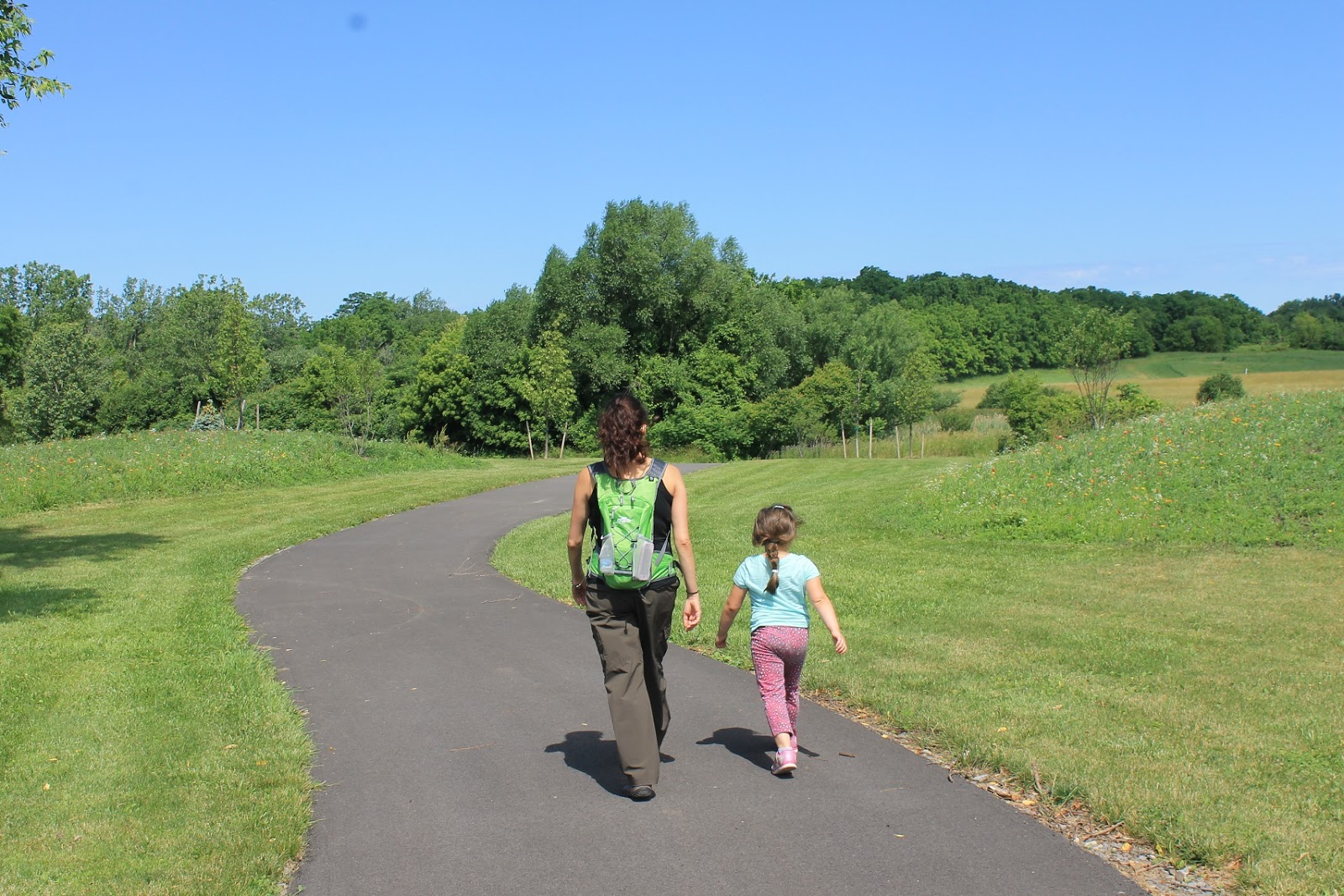
The blacktop-boardwalk-stone section is perfect for walkers and joggers of any age and skill level. It is so flat and so well maintained that young parents can push a stroller through there with no problem. On our hike there we even saw some bicyclists from the Canalway trail using that stretch.

Those trail conditions change once you get into the woods. The lengthy loop of trails in the forest are soft and muddy in a few spots, but for the most part they are in very good shape. Those wet areas don’t allow the weed cutting machines to get in there often, so you will encounter some stretches in the lower areas with weeds that are shin to knee high. I was really surprised they weren’t trampled by visitors, which, I guess, speaks to the low number of hikers using the full length of the trail.

To me, the wooded portion is a normal hiking trail. But, those who prefer the civilized Canalway trail or were spoiled by the first couple of sections might be turned off by the wildness, especially if they are wearing shorts.

Press on. Horvath and others have done a bang-up job in putting a trail system in place in the forest.  

When you come to the entrance of the woods, don’t be put off by the “Posted. No Hunting” sign. You’re not entering private property. That’s just the town’s way of telling hunters they can’t pursue game in the Preserve.

The first portion of the wooded hike is in some lowlands of young-growth trees dominated by ashes (which might cause it to look like a skeletonized ghost town in a few years as the emerald ash borers take up residence). In this section we encountered song sparrows, yellow warblers, catbirds, cardinals, and orioles.

The second portion is on some slightly higher and much-drier terrain with some older trees with more diversity. Here, we saw deer, woodpeckers of various species, jays, and wood thrushes. Any place you can hear the flute-like calls of the thrush is a good place – they are a bird is serious decline all across the country.

As you get into the higher section, you will encounter very little undergrowth because of the sun-blocking canopy of the larger trees. So, to help you navigate the trail, there are orange ribbons tied to many trees.

This is a loop trail in the woods, so it will take you back to where you entered, unless you choose to exit in two other locations which will allow you to walk at the edge of the grasslands along the forest.         

I suggest you stay on the trails, especially when you exit the forest. Don’t explore the high grasses. When traipsing through grasslands it is too easy to step on songbird nests and ruin the environment. There are more than enough trails to keep you engaged with the wildlife.

In closing…

The entire hike across the Lytle Preserve from start to finish took us 50 minutes as we took it at a leisurely nature-watching pace with our 5 year-old daughter leading the way and my 3-month-old strapped to my chest – this was his first nature hike.

Visiting the Lytle Nature Preserve offers a nice respite from city life (the city of Lockport is literally just around the corner) and it gives canal walkers a change of pace from the sterile sameness of the canal towpath.

Let’s hope that more people start to use this wonderful trail and experience the wildness that the Lytles so wisely thought that the whole world deserved. This is a gem truly worth exploring on the Niagara Frontier.   


Thursday, July 6, 2017

Liability bill will lead to fewer doctors in New York


When vacationing in this beautiful state of ours, the presence (or lack) of medical care is something you probably pay attention to if you like any number of outdoors pursuits or you are the parent of a young child. You hope that you or your kid will never break an arm or twist an ankle, but you should be prepared in the event that does happen. 

If you’ve ever spent some time in the Adirondacks, you’ve likely noticed that doctors are incredibly rare.

There are so few doctors’ offices to pull from that back in 2014 ago the emergency room at Lake Placid’s Adirondack Medical Center went part-time, from 24 hours to 15. Mind you, Placid is a world-renowned tourism destination where injured skiers, hurt hikers and lost campers are not uncommon from Whiteface and the High Peaks.

If you are familiar with the popular Old Forge area in the Central Adirondacks, there are 3 medical offices there. There are no other doctors between OId Forge and places like Long Lake, Indian Lake, and Remsen. If a resident or visitor needs pediatric care, they have to drive more than an hour to Utica or Lowville. It’s that long of a painful ride to ERs in those same communities.

This is something that’s not unique to the North Country.

Similar shortages can be found throughout rural areas of Central New York and the Southern Tier.

In all, over 1,000 doctors are needed statewide just to keep up with demand.

That’s a staggering number, and one that’s growing as physicians age-out or close their practices and seek full-time employment at hospitals and urgent care centers.

There are a variety of factors that have led to this healthcare crisis. Above all, it’s tough for a doctor to earn a fair income in rural areas with fewer potential patients.

He or she needs to earn an income commensurate with the task (and pay off college debt), provide living wages for staff, invest in the latest in medical equipment and have a facility from which to operate. The potential of having a better business model and greater incomes in the suburbs or urban locales is what draws doctors to where the people (and, in turn, profits) are.

When you are talking about those special doctors who try really hard to stay in rural areas and make a living while tending to a higher calling, every cent truly matters.

When the economics are against them we can’t allow the government to make things worse.

And that’s exactly what the New York State legislature is doing.

Both houses passed a bill -- now awaiting Governor Cuomo’s signature or veto -- that would expand medical liability in the Empire State. This burden would dramatically increase the cost of the already-expensive medical malpractice insurance policies held by doctors and further expose them to the considerable monetary risks that are unique to their profession.

It’s not as if New York is lacking in malpractice payouts. The state’s laws and judicial system has New York doctors leading the nation in that regard.

Malpractice payments on a per capita (per resident) basis are over $36 here. New Jersey comes in second place at $29 while California, a land once believed to be as litigious and generous as New York, comes in at just under $6 per resident. Total malpractice payments in New York State in 2014 alone were nearly $714 million.

It’s not that we have a disproportionate number of bad doctors. It’s just that we have a system that penalizes like none other. State laws and the insurance woes they create hurt everyone, even the successful and most-skilled.

It’s no wonder WalletHub ranks us as the worst state in the union in which to be a doctor as based on 14 critical metrics.

It shouldn’t be that way.

As with any industry, we should make it attractive to do business here.

Expansion of malpractice liability won’t do that. It will only serve to drive doctors away, putting millions of New Yorkers and those who spend their tourism dollars here at risk if, God forbid, the worst ever happens and care is needed. 

Here’s hoping Governor Cuomo truly values the health and safety of upstate New Yorkers and vetoes this bill. 


From the 10 July 2017 Greater Niagara Newspapers

Thursday, June 22, 2017

EXPLORING THE NIAGARA FRONTIER: The wild strawberry

When hiking with the uninitiated in the Niagara Frontier’s June wilds I like to tell them that they haven’t lived until they’ve had a wild strawberry.


It certainly sounds like an absurd statement, doesn’t it? If you’ve had one strawberry, you’ve had them all.

Not so.

The wild strawberry is nothing like our cultivated specimens. The flavor is intense, at a magnitude of that of the farmed varieties. They are juicier and seem like an entirely different fruit. Incredible.

After having one you can see why the French began developing and cultivating strawberries in the 1700s. But, by doing so and making larger fruits, they lost much of the flavor (don’t get me wrong – farm raised strawberries are still pretty good).

“Larger fruits,” you ask?

Yes, wild strawberries are nothing like those developed by Man. They are tiny little things, from two-
tenths to four-tenths of an inch in length. You’d need to find dozens to make for a snack of any size. And, that’s not going to happen. You’d be lucky to find just one dozen strawberries in a patch. You can find these berries during the second half of June, in open areas of woodlands, pastures, and places that some naturalists consider “waste areas” (roadsides, ditches, rail beds, etc).

They like full sun or else the plant cannot produce fruit. Prior to the strawberry appearing, you will see a dainty white-petaled flower with a yellow center that will stay in bloom for most of the second half of May.

The leaves have saw-toothed edges and come in threes. The adage “leaves of three, let it be,” (which
many people apply to poison ivy) has to be ignored if not altered, or you could destroy these wonderful plants in your lawn or hedgerow.

There are plenty of tasty plants (like clovers and wood sorrels) and beautiful plants (trilliums, Jack in the Pulpit) with three leaves, so proceed with caution before spraying Round-up on these plants. If you do find the flowering strawberry plants in the spring, weed around them so you can enjoy the fruits.

While we’re talking about the strawberry, let’s end on a technical note. Maybe you’ll win Jeopardy! someday with this one.

The strawberry is not a berry. By definition a berry has seeds inside of it. The seeds are on the outside of the strawberry, which means the strawberry is an aggregate accessory fruit, which is a nicer way of saying “ovary” (who really wants to say, “Boy! I could go for some ovaries right now”?). Each of those individuals items that you see as seeds on the outside of the strawberry are actually individual fruits and the seeds are inside of them.

But, enough of the technical mumbo-jumbo. You really need to get away from the computer, go
outdoors and have a wild strawberry…you haven’t lived until you’ve done so.


From the 22 June 2017 All WNY News

Tuesday, June 20, 2017

Property taxes: What’s fair?


A few weeks back I cut short a day of work to make the 5 hour round-trip to Bolivar in Allegany County to contest my camp’s assessed value during the town’s Grievance Day. Despite being on a remote seasonal road, a mile and a half from electricity, and having no structures on the land, my assessment doubled while the assessor estimated that my taxes will rise by more than half.

Last week, my travels and efforts proved all for naught: A care package came in the mail from Bolivar officials saying my grievance was denied and that they would stick with their initial findings. 

The frustration that I’ve had over this brings to the surface the vast unfairness that is inherent to New York’s property model. 

Spend some time mulling over these questions…

Why should senior citizens on fixed incomes who have been paying into the system their whole adult lives continue to pay high taxes for things they won’t use anymore, but once did and once paid for accordingly through taxation at that time?

In comparing properties of equal size, why should a childless couple pay as much as a family of four, when the family of four consumes far more in public services (especially public schooling)?

Why should someone who loves his home and wants to make it better with a swimming pool, patio or an addition have to suffer the consequences at reassessment and end up paying more in taxes than someone who left his land idle?

In rural locales like Niagara County, why should farmers carry the highest portion of the revenue burden just because they happen to own vast tracks of land? Are they receiving a proportionate amount of services?

Why should property owners pay so much for Medicaid (in most New York locales it’s 52 to 64 percent of the county tax) when it should be the obligation of the population as a whole to fund this forced benevolence deemed to be so necessary?

How is it just that municipalities and schools in Allegany County and the Adirondacks can reap revenues from who are basically absentee landowners living elsewhere (camp owners) who come to town just a few weekends and weeks a year and acquire almost no benefit from the taxes they’ve paid? Why should those non-resident property owners be excluded from having a vote in how their taxes are being used in the places where they are paying them?

Beyond those glaring displays of wrong, consider the very act of property taxation itself. You are led to believe – and even possess legal documents that show as much – that you own your property. You really don’t; ownership is only theoretical. It’s more accurately stated that you are renting the property from your local governments and school districts at a premium, because, if you didn’t pay your taxes it wouldn’t take long for that governing body to take that property from you --- even if the mortgage was fully paid-for. How is that fair? It would be no different than someone taxing your savings account – after all, it is property, isn’t it?

This travesty carries special meaning in New York State, where property taxes are 57% above the national average. Across America people think of their property taxes in terms of hundreds of dollars; here, we think of them in thousands of dollars.

Let’s look at one of the extremes. One of my clients from Tennessee pays a paltry $660 per year in property taxes for his 2,800-square-foot suburban new-build. In comparison, my coworker who lives in North Tonawanda has a similar home for which he pays $6,800 in taxes annually. We’re talking magnitudes of difference in taxes paid.

New York’s cure for this problem was not to cut property taxes, but rather to still allow them to grow, but only at a supposedly-stunted rate (the 2 percent tax cap). That’s still a princely sum: Crunch the numbers of what would become of your taxes after just 5 years of capped increases.

The extreme view would see property taxes abolished. We know that will never happen. But, a myriad of changes could be accomplished to mitigate the unfairness of property taxes in the Empire State. Just a few of those ideas discussed in this column over the past 12 years: replace the state’s Medicaid program with an HMO-driven voucher system; utilize clawbacks on businesses that break their promises to IDAs; utilize assessment caps and adjust assessments to true market value (how in the world did assessments go up during the Great Recession?); and add another 1 to 1.5 percent on sales taxes across the state to use a fairer consumption-driven tax to decrease property owners’ contributions to Medicaid.

Those are all common sense measures that could cut back on some of the unfairness and princely sums that are inherent to our property taxes. But, instead, it seems like the state legislature, Governor and local governments prefer to maintain that air of unfairness, taking advantages of citizens and businesses alike, further damning the once proud Empire State.


From the 26 June 2017 Greater Niagara Newspapers