Tuesday, July 2, 2024

Don't overlook the Canalway Trail


We are blessed with incredible public assets in Niagara County -- from town parks to state parks – that allow locals and tourists alike to explore the Niagara Frontier and enjoy the outdoors.


One of those assets is, for vast stretches, lightly used: The Canalway Trail.


It may be more familiarly known as the “towpath” because back in the Erie Canal’s heydays of the 1800s it was walked by the mules and horses that pulled packet boats and barges. In the first half of the 1900s, it became a freeway of sorts for hoboes, who set about for income from harvests and odd jobs. 


Maybe it’s those original utilitarian purpose that keeps people away. Maybe it’s the misbelief that it’s not interesting enough. Maybe it’s the fact that it’s everywhere and everyday – something we pass over on our commutes and overlook because it’s just “there”.


Whatever the reasons may be, I encourage readers to cast those thoughts aside and appreciate the miles of trail awaiting you.


This column will periodically look at stretches of the trail, giving you insight into local history and natural history. We’ll begin by looking at the trail as it heads from the Orangeport Road bridge in Gasport to the Canal Road bridge in the town of Lockport. This is my favorite part of the trail.

 
Round-trip from the Orangeport parking lot it’s a good 4 mile hike. Moving at a fair pace, a hiker can accomplish the hike in an hour and 15 minutes, longer if you stop to rest, fish, or watch wildlife.

 
Getting there is easy. Most readers will make their way to Gasport on Route 31. Just to the west of the hamlet is Orangeport Road. Within a few hundred feet of getting onto Orangeport Road, you will cross over the canal. Once you do, quickly approaching on your right will be Berner Parkway. Take Berner all the way to its end. The turnaround there is the parking lot for the trail.

 
It’s called Orangeport because back in the 1800s once stood an inn that was frequented by canal boatmen – it was painted a bright orange as a means to attract attention and imbed the hotel in memories.

Upon walking out of the lot, go towards the bridge and continue heading that direction.


This portion of the trail is stone dust perfectly groomed by the Canal Corporation. You can walk, run, bike, or push a stroller with ease; it’s friendly to all types of use.


For the next two miles, you will be graced with pastoral scenes to the north. The closest road is Slayton Settlement, a mile north, so you won’t encounter houses on the trail side of the canal until you get to the next bridge. Instead, you’ll see orchards, small forests, and thousands of acres of crops.


The lack of civilization means the trail puts you close to wildlife. It’s not uncommon to see deer or turkeys coming out of the woodlots. In the spring, trees lining the trail are chock-full of warblers, the “butterflies of the bird world.” During the summer and fall, avian fishmongers love this stretch – kingfishers, green herons, and ospreys. You might even see a bald eagle fly overhead.


Enjoy the wildflowers along the path, especially in summer and fall. Many people derisively look at late-season flowers as weeds. They are not. The whole palette of colors is there, as you can see hawkweed, morning glories, chicory, and butter and eggs to name a few.


Along the trail you will see 3 different streams that get their water from PVC pipes that run from the canal. The purpose is to keep the streams flowing so farmers can use the water to irrigate their crops. A fourth creek doesn’t get canal water, flows under the canal, and has a wooden fence high above its culvert. This creek is one of the more interesting in the region as its natural gas is the reason why Jamesport was renamed Gasport in 1826.

 
Across from that creek houses show up on the south side of the Erie Canal. The first one might look familiar. Prior to the late-1990s it was Camp Margaret Castle, owned by the local Girl Scouts who also rented it out to Boy Scouts for their camporees.


Approximately 400 feet past that you will come to a pleasant picnic spot, a grassy area with boulders and a bench.

 
Further down the trail you will come upon the Canal Road bridge. This single-lane steel bridge was built in 1900 and is still in great shape. This is where most hikers turn around and head back.


Make it a point to hike the Erie Canal’s towpath this year. You might find yourself falling in love with this trail system, especially along this quiet, rural stretch.


Hope to see you on the trail!


From the 19 June 2024 Greater Niagara Newspapers

Hire the Class of 2024. Now


It was reported last month in the Wall Street Journal that employers are in no rush to hire recent college graduates. Hiring managers plan to bring on substantially fewer of them than they did last year, citing the need for years of experience and the impact of artificial intelligence on so-called entry-level tasks. Graduates who were interviewed for the article and began their job searches before having diploma in hand say they’re seeing it, from limited responses to their resumes to rescinded offers to ghosting.


I would strongly suggest such employers rethink their strategies and go all-in with the Class of 2024 – they bring too much to the table to pass up.


Last month, I had the honor of participating in the commencement ceremonies at SUNY Brockport as part of President Macpherson’s platform party. I sat on the stage, dressed in cap and gown, where I got the chance to see and celebrate nearly 2,000 graduates as they realized their dream.


Graduation is always a high-energy, high-emotion scene, but this year’s event had more smiles, heartier handshakes, and louder cheers than ever because of the huge sense of accomplishment to be had in navigating and succeeding in the minefield we call the 2020s.


Just think of everything these young people faced.


The dawning days of the pandemic in 2020 saw the last few months of their senior year of high school transformed into online learning that neither they nor their teachers were prepared for. The Senior Prom was cancelled, along with spring sports. Then, graduation -- the heavy, emotional end to childhood and the past 13 years of roaming the halls of their alma mater -- was canceled or turned into a drive-through or virtual event that lacked the magic they and their families had long hoped for.


Heading to college that fall was their first extended time away from home and their parents. Leaving that comfort and protection is stressful enough for most kids, but imagine doing that less than a half-year removed from the start of lockdowns, with the concerns of Covid and institutional and government protocols weighing heavily on their life on campus and off, impacting everything from how they learned to how they moved about campus to how they made new friends in that new, strange place.


As if that wasn’t enough, that first freshman semester also saw the stresses of civil unrest that had overtaken the nation and deeply affected many. 


Over the course of their four years in college they saw a gradual return to normalcy on campus – like going all-in with classroom learning, ditching the masks, and socializing – but things in the outside world continued to weigh heavily on them. Out on their own for the first time, they were hit hard by relentless inflation that destroyed their already tight budgets. At the same time, supply chain issues totally changed their expectations for some college and personal experiences. Then, the world saw conflict in Ukraine and the Middle East, the latter dividing people and leading to protests on various campuses as they closed out the senior year of a tumultuous college career.


The Class of 2024 experienced a lot. They matured in a hurry, having thrust upon them a lifetime of situations in a matter of four years. They took what was thrown at them, adapted, and met that all head-on. 


That alone should make them marketable. But, also consider how this impacted their education in remarkable ways.


Nursing students received experiential learning in the most chaotic and fluid public health environment in over a century, directly seeing how hospitals navigated everything around Covid. They were thrown right into the fire.


Business majors were able to see and discuss their textbook theories in the real world as issues of supply and demand and inflation dominated. They even had the chance to deeply analyze crisis management while businesses navigated those issues and the pandemic.


Sociology students saw the events of 2020 and 2021 – from societal upheaval around Covid to social unrest – as a real-time means to dig in deep to their studies, to see how theory played out in the hearts and minds of individuals and the collective society.


College students aspiring to be teachers learned first-hand new teaching tools (such as remote and virtual learning) just as all of the education world itself learned them. They also saw the negative impact lockdowns had on kids in primary schools, which readied them to help fix what’s now broken.


And, public administration majors saw the good and the bad of what government can do during crises, providing them a perspective of things to do and not do if ever they are the ones in charge.


What I’ve written here only touches the surface of what the Class of 2024 faced and overcame, learned and applied, did and will do. Any human resources manager worth their salt should put these graduates’ resumes at the top of the stack. The benefits that will be afforded their employer are too many to mention, and too many to pass up. This class is special.        


From the 12 June 2024 Greater Niagara Newspapers and Wellsville Sun   

Exploring the Western NY Wilds: The backyard sparrow


One of the joys of being a birder or gardener is seeing what creatures you share your yard with. There’s something special about birds nesting around your home – you see them every day and experience their life moments, from building their nests to hatching their eggs to feeding their chicks to seeing those babies fly off. It’s almost like you see your home life played out in theirs (but much more quickly).

There’s one bird that affords many of us the opportunity to be part of their lives, a tiny one that’s as equally at home in the woods as it is in our backyards – the chipping sparrow.

With a reddish cap, brown back, and unremarkable grey underside, this diminutive sparrow, coming in at just 4.5 to 5 inches in length, seems like a slim-and-trim sprite compared to the common house sparrow, which is the fat sparrow that’s more than an inch longer that you see in the villages and cities, begging for French fries. The chipping sparrow isn’t a beggar, but it can be as tame as the house sparrow, allowing you to get quite close to them. Unlike other birds, they’ll actively feed near you when you’re working or relaxing in your yard.

Chipping sparrows have a mixed diet. They eat insects and seeds which they collect while foraging about on the ground.

In wild environments, these birds are found in open woodlands in the East and in mountain meadows out West. A backyard is perfect for them as it gives them open space and plenty of opportunities for nesting and shelter – if you have coniferous trees. Chipping sparrows prefer to nest in pines and spruces. I have quite a few Norway spruces of various ages, so it’s perfect habitat for them – I typically have three pair of these birds nesting in my yard. 

These small sparrows have a song that some compare to smaller creatures – insects. It is a series of “chips” (hence the name) that can be as few as three chips or as many as seven played out in rapid succession.

Chipping sparrows are with us only in the spring and summer months. Every fall they make their way south – to Florida, Mexico, and parts of Central America – to spend their winters.

Enjoy them while they’re here. They make for a pleasant member of our summer landscapes. They’re good neighbors to have. 


From the 11 June 2024 Wellsville Sun

D-Day's Hometown Hero


Even today, 45 years after his passing, John Wayne remains an American icon, recognized across generations. The charismatic tough guy left on indelible impact on audiences and popular culture.


One would think that if he took on a role portraying a local person, that individual would, like Wayne, be something of a household name in these parts.


Sadly, that’s not the case. 


If you ask your typical Niagara County resident who Benjamin “Vandy” Vandervoort is you’ll get a shoulder shrug. So few people know of him and what he did, even though Wayne took on a starring role as Vandervoort in the film the Longest Day. 


This week, upon the 80th anniversary of D-Day, let’s shine the spotlight on this decorated participant of that event (and others), a war hero who was born and raised right here in the County.


Vandervoort came into this world March 3, 1917 in Gasport and spent his formative years there before heading off to Washington College in Maryland. He enlisted in the Army in July of 1937 at the age of 20, more than four years before the US entered Would War II. 


In 1940, he was transferred to the newly-formed airborne division and quickly worked his way through the ranks due to his leadership and calm under pressure as a paratrooper. He was promoted to lieutenant colonel on June 1st, 1944, just days before the Allied invasion. He was the commanding officer of the 2nd Battalion, 505th PIR – 600 men in total -- during the airborne landings in Normandy.


His landing in darkness early the morning of D-Day wasn’t a soft one -- he fractured his leg above the ankle. Rather than holding back and being evacuated, he pressed forward, wrapping his leg and using his rifle as a crutch until a French resident gave him a set of crutches.


He repaid her for her kindness by, despite the significant injury, leading the liberation of the village of Ste. Mère Eglise. Doing so was a remarkable task: Even with that injury which limited his mobility, he personally led his men against German columns that had far greater resources in terms of manpower and firepower. At the front line, he subjected himself to intense enemy rifle, machine gun and artillery fire. Obviously inspired by his actions, his men were victorious in their critical part of the D-Day operations.


For that, he was awarded the Distinguished Service Cross. It wouldn’t be his last.


Upon healing his leg – well, at least the best he could in little time -- he went right back to the front. Just 3 months after D-Day, he participated in Operation Market Garden, which was immortalized in the film a Bridge Too Far. Then, three months after that, he took part in the Battle of the Bulge, which is where he earned his second Cross.  In what some considered a suicide mission at first, he led an effort that successfully secured highway and rail bridges. To make that happen, Vandervoort set-up at a forward and exposed position to personally supervise and coordinate the progress of the infantry and armored vehicles. His total disregard for his own safety made possible that victory. The risk assumed ended his battle career – an enemy mortar exploded near him and the shrapnel from the blast took one of his eyes. Although he could no longer fight, he spent the rest of his life in service to his country in the Foreign Service and the Central Intelligence Agency.  


Over the course of his magnificent military career his awarded those two Distinguished Service Crosses, a Bronze Star with “V” for valor, and three Purple Hearts. In the early ’90s, the United States Army Center for Leadership selected a colonel or lieutenant colonel to recognize from every American War. Vandervoort was selected as the outstanding ground battle commander for all of World War II.


It’s no wonder why Charlton Heston fought hard to secure the acting role that ultimately become John Wayne’s -- Hollywood’s biggest names wanted to be Benjamin Vandervoort. 


Vandervoort died in 1990 in Hilton Head, South Carolina. At the time of his passing his neighbors there were surprised by his accomplishments because he never spoke of what he did. He wasn’t one to boast, and if the topic of the Second World War came up he cited the accomplishments and sacrifices of his men, not his.


He flew under the radar in those later years. And, that’s what has happened to him here, in Niagara County, his place of birth, the place that provided the foundation for his incredible courage and leadership.


This week, as you think of D-Day, think of Vandervoort and afford him the acclaim and respect he has long deserved here in his hometown. He was a hero for his generation and he should be for this generation and many others to come, a defining symbol of the greatness that can come from a small town. 


From the 06 June 2024 Greater Niagara Newspapers and Wellsville Sun
Exploring the Western NY Wilds: This bird has one in the oven


Learn more about the “dominant warbler of the woods”

By Bob Confer,

In the lowlands of Allegany County, and especially around the rivers and streams in those valleys, the yellow warbler reigns supreme. In such locations, it is the most abundant and recognizable of the warblers. With its bright yellow plumage and its habit of flying limb to limb chasing insects, it’s what one would expect a warbler – known as the butterflies of the bird world – to look like and act like. 

Head into the neighboring hills and mountains and it’s a different story. There, the telltale teacher-teacher-teacher-teacher call of the ovenbird rings through the springtime forests, cementing its place as the dominant warbler of the woods.

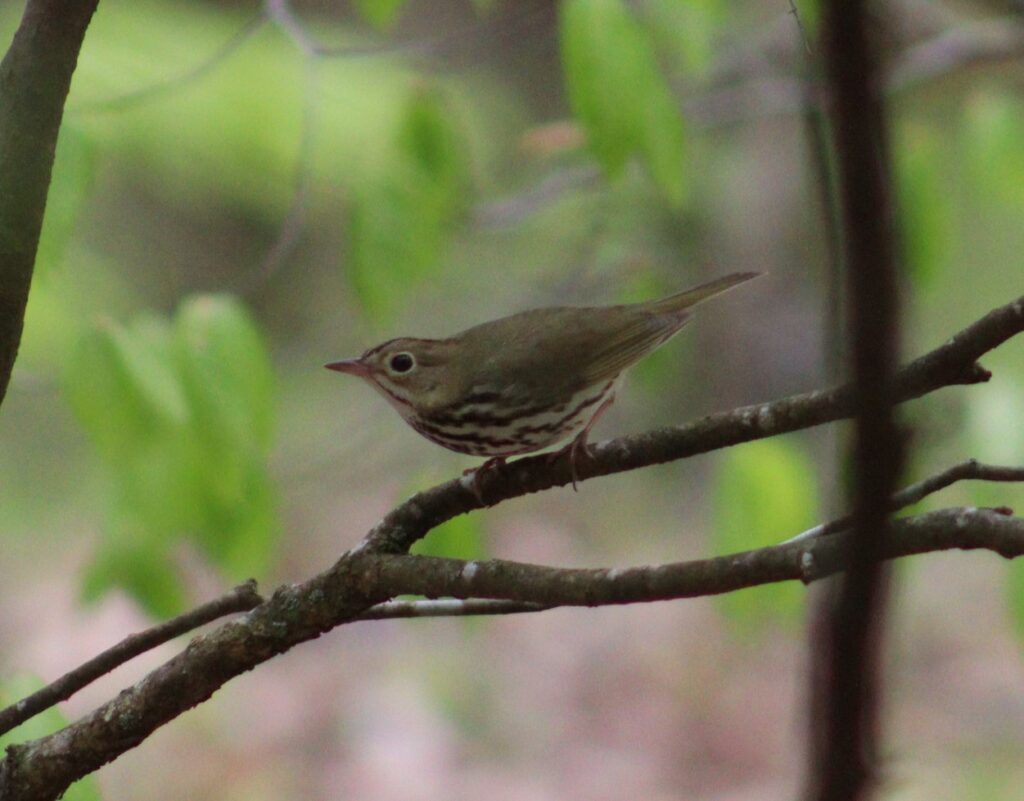
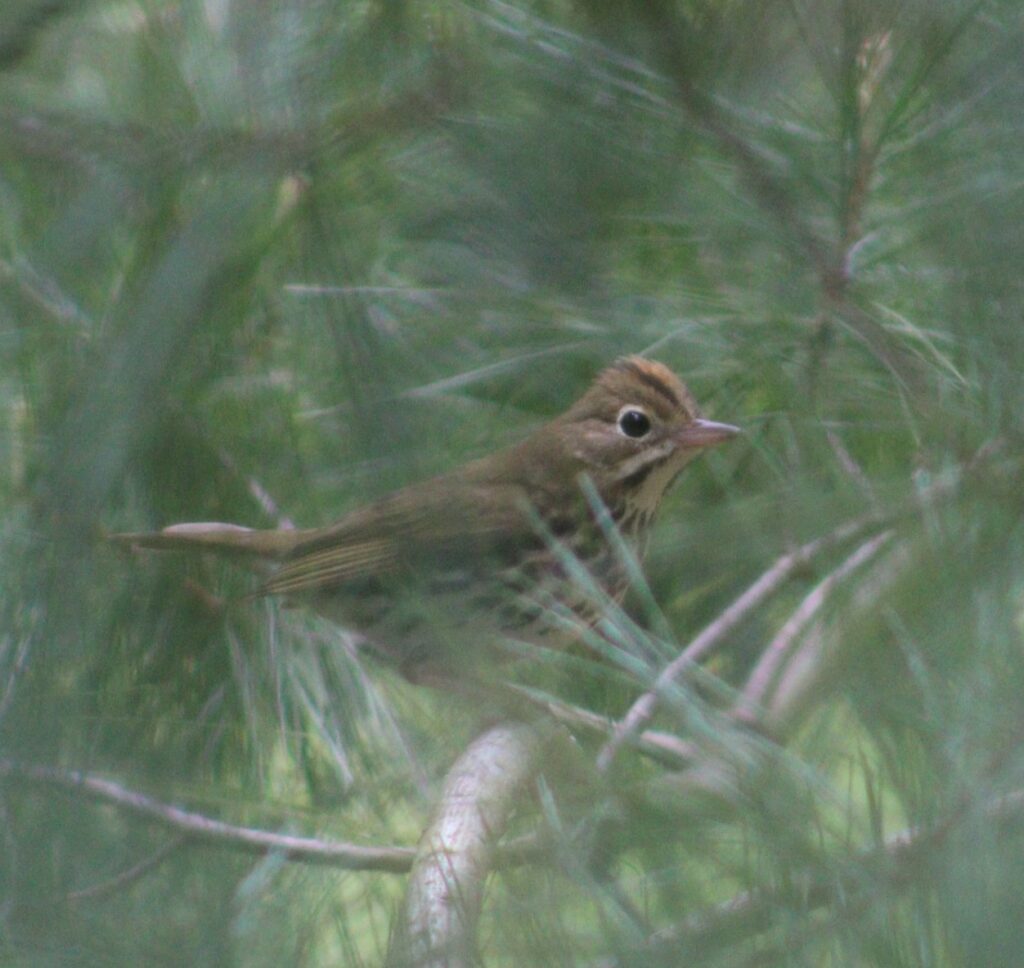
Once seen, it’s not something you’d expect out of a warbler. Some new birders might even think it’s a small thrush: It lacks the yellows, greens, and blues of other warblers; instead it has a brown back and a white breast with black spots. The only hint of warbler is the small orange crown or mohawk. It even feeds differently, walking around on the forest floor in search of its next meal, far below the other warblers feeding in the canopy above.

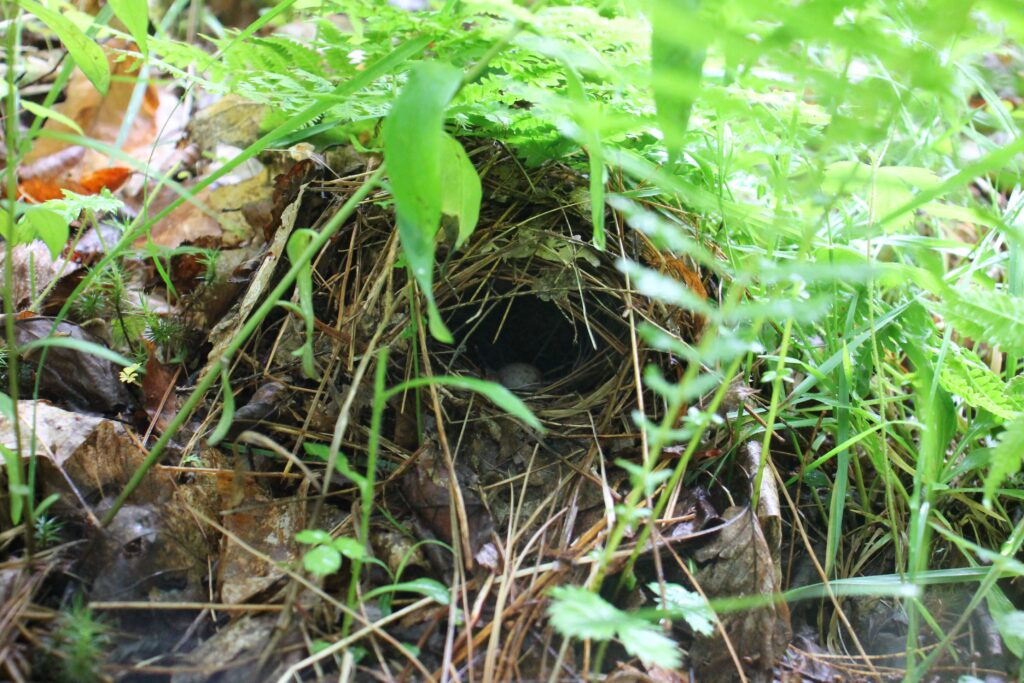
And the ground is where the ovenbird makes its nest, too. There, the bird makes a crowned nest, looking like a pile of leaves and grass. It’s said to look like a Dutch oven – hence the ovenbird’s name. But, it is not an oven…the female just can’t lay eggs in there and walk away. She still has to sit on them. She does so by entering and exiting a side entrance to that tiny nursery.

Well-camouflaged, these nests are very difficult to find. So, if you are walking on a trail in May or June and you flush a distressed ovenbird that nervously hangs out on a nearby branch, recollect where you saw her come from and carefully walk away from that spot, keeping your eye on the ground. She exits the nest at the last possible second when danger is present, so be careful – you are very near the nest!

The ovenbird prefers larger forests (240 acres and more) with older trees (canopy heights in excess of 60 feet). Those spacious and darker forests lack the undergrowth and thick brush of younger woodlands, affording the ovenbird the chance to hunt the ground, where it feeds by sight or by flipping over leaves in search of insects and other invertebrates.  

While many other species of birds are in decline, the ovenbird is not. Since the close of World War II, numerous family farms have shut down across the state and reverted to forest. As that has happened, the ovenbird has seen a rebound to numbers closer to those of the pre-colonization days. The Breeding Bird Atlas of New York State has showed an significant increase in breeding populations that, only in the past twenty-five years has slowed down to an 1.5% annual increase in numbers, which is still pretty special given the dire prospects facing other birds across North America.

This month, appreciate this common and loudly-singing sprite of our forests…just be careful where you walk. 


From the 03 June 2024 Wellsville Sun