One of the joys of being a birder or gardener is seeing what
creatures you share your yard with. There’s something special about
birds nesting around your home – you see them every day and experience
their life moments, from building their nests to hatching their eggs to
feeding their chicks to seeing those babies fly off. It’s almost like
you see your home life played out in theirs (but much more quickly).
There’s one bird that affords many of us the opportunity to be part
of their lives, a tiny one that’s as equally at home in the woods as it
is in our backyards – the chipping sparrow.
With a reddish cap, brown back, and unremarkable grey underside, this
diminutive sparrow, coming in at just 4.5 to 5 inches in length, seems
like a slim-and-trim sprite compared to the common house sparrow, which
is the fat sparrow that’s more than an inch longer that you see in the
villages and cities, begging for French fries. The chipping sparrow
isn’t a beggar, but it can be as tame as the house sparrow, allowing you
to get quite close to them. Unlike other birds, they’ll actively feed
near you when you’re working or relaxing in your yard.
Chipping sparrows have a mixed diet. They eat insects and seeds which they collect while foraging about on the ground.
In wild environments, these birds are found in open woodlands in the
East and in mountain meadows out West. A backyard is perfect for them as
it gives them open space and plenty of opportunities for nesting and
shelter – if you have coniferous trees. Chipping sparrows prefer to nest
in pines and spruces. I have quite a few Norway spruces of various
ages, so it’s perfect habitat for them – I typically have three pair of
these birds nesting in my yard.
These small sparrows have a song that some compare to smaller
creatures – insects. It is a series of “chips” (hence the name) that can
be as few as three chips or as many as seven played out in rapid
succession.
Chipping sparrows are with us only in the spring and
summer months. Every fall they make their way south – to Florida,
Mexico, and parts of Central America – to spend their winters.
Enjoy them while they’re here. They make for a pleasant member of our summer landscapes. They’re good neighbors to have.
Even today, 45 years after his passing, John Wayne
remains an American icon, recognized across generations. The charismatic tough
guy left on indelible impact on audiences and popular culture.
One would think that if he took on a role
portraying a local person, that individual would, like Wayne, be something of a
household name in these parts.
Sadly, that’s not the case.
If you ask your typical Niagara County resident who
Benjamin “Vandy” Vandervoort is you’ll get a shoulder shrug. So few people know
of him and what he did, even though Wayne took on a starring role as
Vandervoort in the film the Longest
Day.
This week, upon the 80th anniversary of
D-Day, let’s shine the spotlight on this decorated participant of that event
(and others), a war hero who was born and raised right here in the County.
Vandervoort came into this world March 3, 1917 in
Gasport and spent his formative years there before heading off to Washington
College in Maryland. He enlisted in the Army in July of 1937 at the age of 20, more
than four years before the US entered Would War II.
In 1940, he was transferred to the newly-formed
airborne division and quickly worked his way through the ranks due to his
leadership and calm under pressure as a paratrooper. He was promoted to
lieutenant colonel on June 1st, 1944, just days before the Allied
invasion. He was the commanding officer of the 2nd Battalion, 505th PIR – 600
men in total -- during the airborne landings in Normandy.
His landing in darkness early the morning of D-Day wasn’t
a soft one -- he fractured his leg above the ankle. Rather than holding back
and being evacuated, he pressed forward, wrapping his leg and using his rifle
as a crutch until a French resident gave him a set of crutches.
He repaid her for her kindness by, despite the
significant injury, leading the liberation of the village of Ste. Mère Eglise.
Doing so was a remarkable task: Even with that injury which limited his
mobility, he personally led his men against German columns that had far greater
resources in terms of manpower and firepower. At the front line, he subjected
himself to intense enemy rifle, machine gun and artillery fire. Obviously
inspired by his actions, his men were victorious in their critical part of the
D-Day operations.
For that, he was awarded the Distinguished Service
Cross. It wouldn’t be his last.
Upon healing his leg – well, at least the best he
could in little time -- he went right back to the front. Just 3 months after
D-Day, he participated in Operation Market Garden, which was immortalized in
the film a Bridge Too Far. Then,
three months after that, he took part in the Battle of the Bulge, which is
where he earned his second Cross.In
what some considered a suicide mission at first, he led an effort that
successfully secured highway and rail bridges. To make that happen, Vandervoort
set-up at a forward and exposed position to personally supervise and coordinate
the progress of the infantry and armored vehicles. His total disregard for his
own safety made possible that victory. The risk assumed ended his battle career
– an enemy mortar exploded near him and the shrapnel from the blast took one of
his eyes. Although he could no longer fight, he spent the rest of his life in
service to his country in the Foreign Service and the Central Intelligence
Agency.
Over the course of his magnificent military career
his awarded those two Distinguished Service Crosses, a Bronze Star with “V” for
valor, and three Purple Hearts. In the early ’90s, the United States Army
Center for Leadership selected a colonel or lieutenant colonel to recognize
from every American War. Vandervoort was selected as the outstanding ground
battle commander for all of World War II.
It’s no wonder
why Charlton Heston fought hard to secure the acting role that
ultimately become John Wayne’s -- Hollywood’s biggest names wanted to be
Benjamin Vandervoort.
Vandervoort died in 1990 in Hilton Head, South
Carolina. At the time of his passing his neighbors there were surprised by his
accomplishments because he never spoke of what he did. He wasn’t one to boast,
and if the topic of the Second World War came up he cited the accomplishments
and sacrifices of his men, not his.
He flew under the radar in those later years. And,
that’s what has happened to him here, in Niagara County, his place of birth,
the place that provided the foundation for his incredible courage and
leadership.
This week, as you think of D-Day, think of Vandervoort
and afford him the acclaim and respect he has long deserved here in his
hometown. He was a hero for his generation and he should be for this generation
and many others to come, a defining symbol of the greatness that can come from
a small town.
From the 06 June
2024 Greater Niagara Newspapers and Wellsville Sun
Learn more about the “dominant warbler of the woods”
By Bob Confer,
In the lowlands of Allegany County, and especially around the rivers
and streams in those valleys, the yellow warbler reigns supreme. In such
locations, it is the most abundant and recognizable of the warblers.
With its bright yellow plumage and its habit of flying limb to limb
chasing insects, it’s what one would expect a warbler – known as the
butterflies of the bird world – to look like and act like.
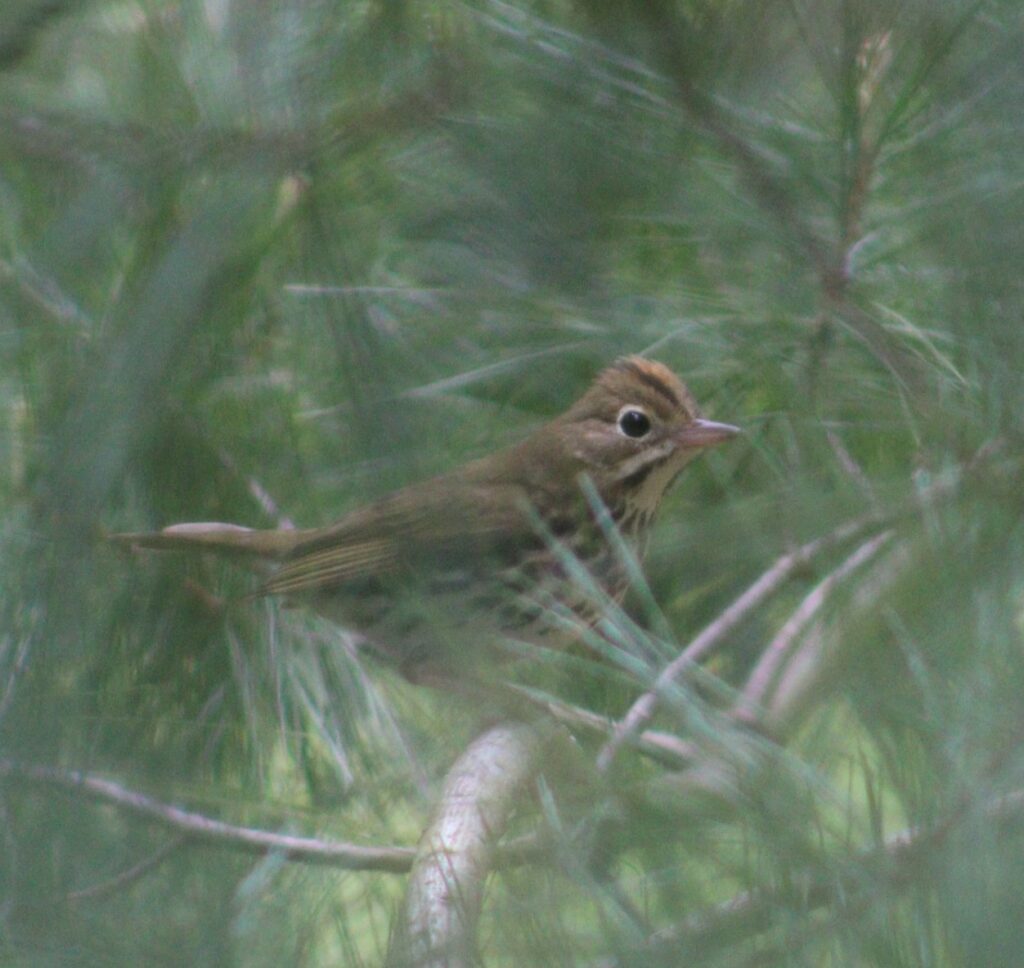
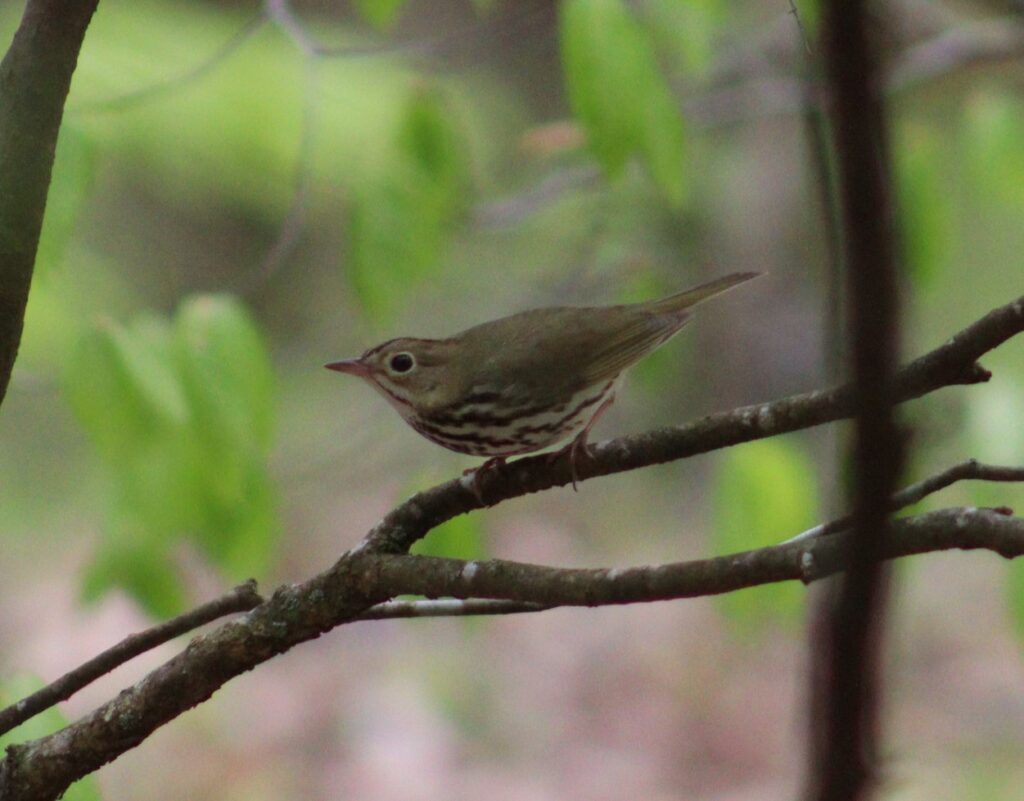
Head into the neighboring hills and mountains and it’s a different story. There, the telltale teacher-teacher-teacher-teacher call of the ovenbird rings through the springtime forests, cementing its place as the dominant warbler of the woods.
Once seen, it’s not something you’d expect out of a warbler. Some new
birders might even think it’s a small thrush: It lacks the yellows,
greens, and blues of other warblers; instead it has a brown back and a
white breast with black spots. The only hint of warbler is the small
orange crown or mohawk. It even feeds differently, walking around on the
forest floor in search of its next meal, far below the other warblers
feeding in the canopy above.
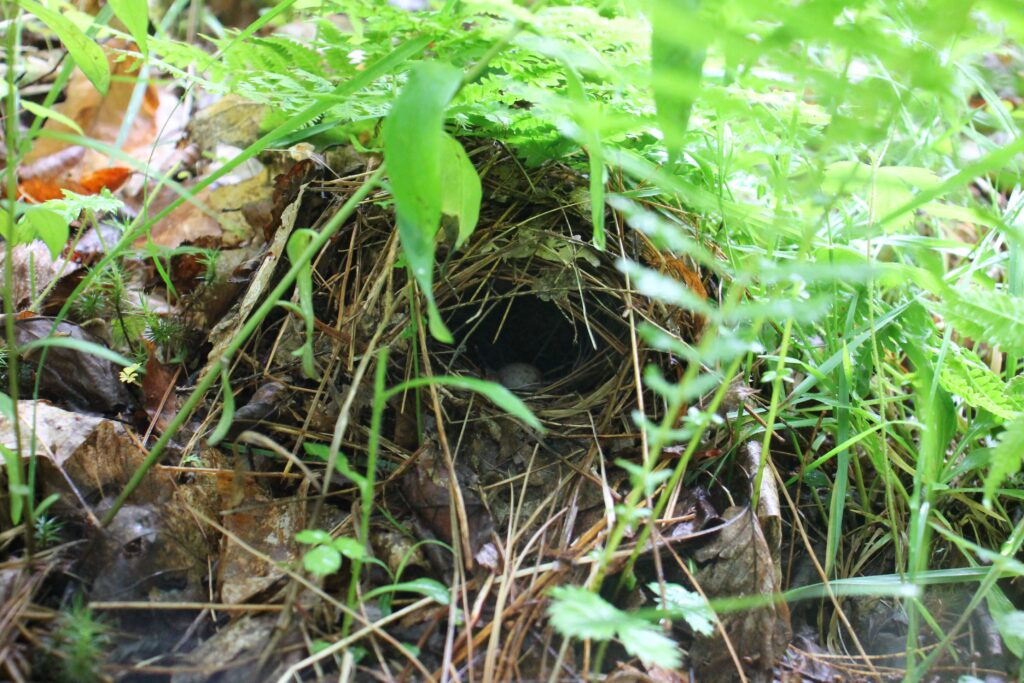
And the ground is where the ovenbird makes its nest, too. There, the
bird makes a crowned nest, looking like a pile of leaves and grass. It’s
said to look like a Dutch oven – hence the ovenbird’s name. But, it is
not an oven…the female just can’t lay eggs in there and walk away. She
still has to sit on them. She does so by entering and exiting a side
entrance to that tiny nursery.
Well-camouflaged, these nests are very difficult to find. So, if you
are walking on a trail in May or June and you flush a distressed
ovenbird that nervously hangs out on a nearby branch, recollect where
you saw her come from and carefully walk away from that spot, keeping
your eye on the ground. She exits the nest at the last possible second
when danger is present, so be careful – you are very near the nest!
The ovenbird prefers larger forests (240 acres and more) with older
trees (canopy heights in excess of 60 feet). Those spacious and darker
forests lack the undergrowth and thick brush of younger woodlands,
affording the ovenbird the chance to hunt the ground, where it feeds by
sight or by flipping over leaves in search of insects and other
invertebrates.
While many other species of birds are in decline, the ovenbird is
not. Since the close of World War II, numerous family farms have shut
down across the state and reverted to forest. As that has happened, the
ovenbird has seen a rebound to numbers closer to those of the
pre-colonization days. The Breeding Bird Atlas of New York State has
showed an significant increase in breeding populations that, only in the
past twenty-five years has slowed down to an 1.5% annual increase in
numbers, which is still pretty special given the dire prospects facing
other birds across North America.
This month, appreciate this common and loudly-singing sprite of our forests…just be careful where you walk.
Everyone is familiar with the common backyard woodpeckers like the
downy woodpecker and its near-twin, the hairy woodpecker. They have what
could be called “typical” size for a woodpecker.
They are quite
unlike their cousin, the pileated woodpecker. If the other woodpeckers
are lumberjacks, then I guess pileateds are the Paul Bunyans of the
woodpecker world — giants.
While a downy woodpecker might be six inches long, pileated
woodpeckers are 18 inches long – the size of a crow – with a 30 inch
wingspan!
Identifying pileateds
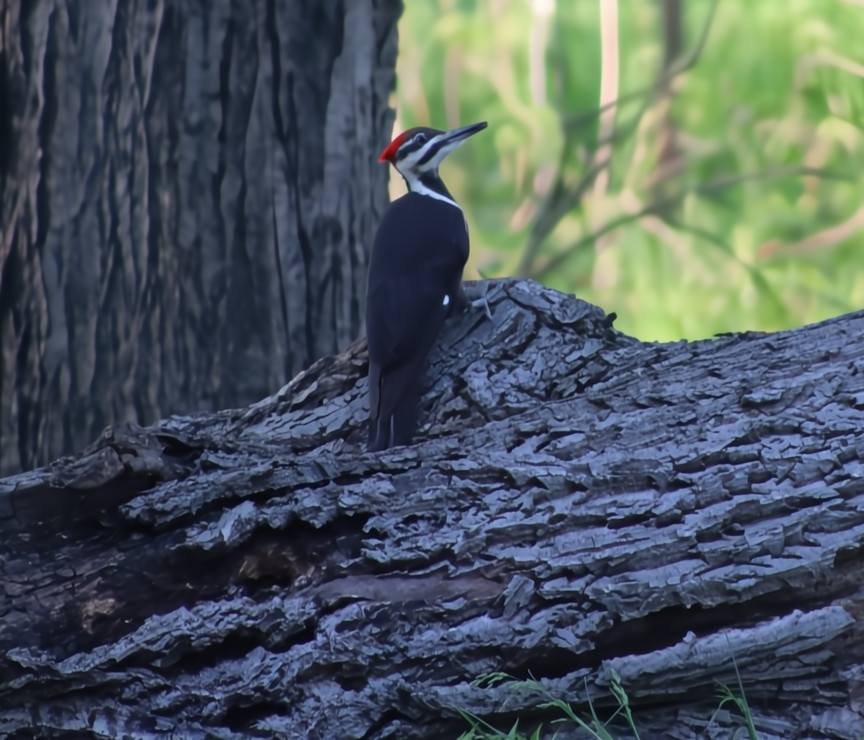
Pileated woodpeckers are unique and can’t be confused with any other
local bird. They are black like a crow, with white stripes on their neck
and face and a large red crest. When they fly, which is done slowly and
deliberately, you will see white wing linings.
Their voice, like their body, is big. Their calls are kind of like
that of the common flicker (the brown and yellow “ground dwelling”
woodpecker you might see in your yard in the summer) but, louder…much
louder. The kuk-kuk-kuk-kuk-kuk call will echo through the forest and
sometimes you can hear them over a half-mile away. Their call is louder
or travels better than turkey gobbles or hawk screams.
Another audible giveaway is their Bunyan-like hammering. When wailing
away on a tree trunk, pileated woodpeckers are just as loud and paced
as a person using an ax to fell a tree. It’s a deep, powerful blow,
nothing like the rapid fire, high-pitched pecking you hear from red
bellied woodpeckers in the spring when they mark their territories by
pecking at hollow limbs.
Where to find them
Pileated woodpeckers need large, dying trees. As our forests age or,
sadly, as they are overcome by sickness and invasive species (such as
beech bark disease and emerald ash borers) they create perfect food
sources for the woodpeckers. Look for them in larger, deeper forests,
which there are plenty of Allegany County.
That’s not to say that they won’t frequent backyards on occasion. My
lawn in Niagara County has a lot of very large trees and is right next
to dairy farm and a county road. Despite that hustle and bustle, and the
closest woodlot being a half mile across a hay field, I see pileated
woodpeckers in my yard a few times a year. If they know there’s lots of
food, they’ll be there.
But, if you hope to see one, the bigger the woods the better. Remember, everything about pileateds is big.
What do pileateds eat?
Pileated woodpeckers don’t eat wood – they eat what eats wood. They
love ants and beetle larvae and will hammer away at an infected tree for
hours and days on end, chipping away the bark and trunk to get at the
insects.
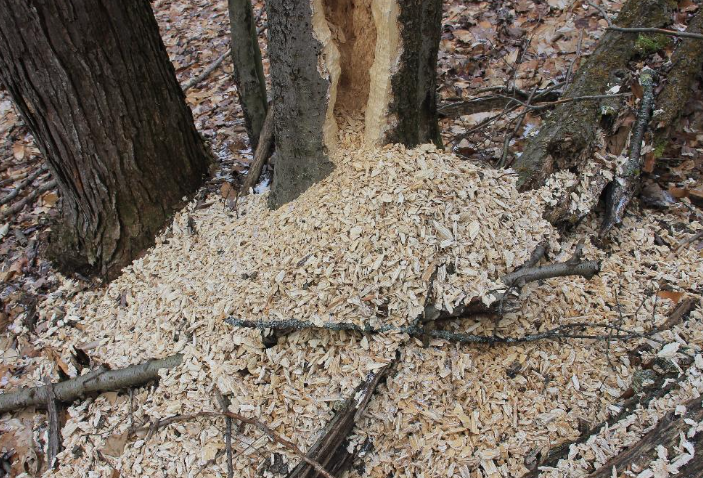
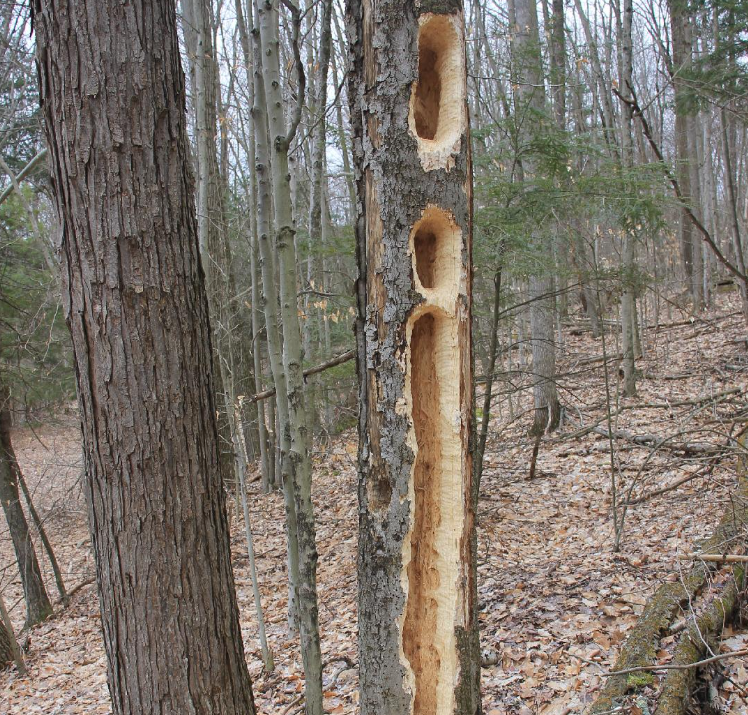
You can’t miss their handiwork. They will carve a channel into a
trunk that might be three to five feet in length, up to six inches wide
and just as deep. Below these rectangular carvings you will see large
chips at the base of the tree, some larger than a man’s hand.
Some of these holes are so Buyan-esque that the trees will actually fall over.
You are familiar with pileated woodpeckers…sort of
You’ve seen the pileated woodpecker, but probably never knew it.
The bird is forever immortalized in pop culture. It served as the
inspiration for none other than the most famous woodpecker of all –
Woody Woodpecker.
The dark body with white markings. The large red crest. The loud
maniacal laugh-like call. The size. A unique character, inspired by a
unique bird.
But, if you hope to see a real life Woody, know that pileateds aren’t as gregarious as their cartoon interpretations.
They are very shy and wary.
So, when out in the woods, be stealthy. Bring binoculars and a telescopic lens for you camera because you won’t get close.
Hopefully you someday get a chance to see one of these giant lumberjacks. You won’t forget the first time that you do.
If when you were a kid – or the parent of a kid – you caught a
firefly, you are familiar with how they look up close when not glowing.
So, it may come as a surprise — even a frustration as you pine for that remarkable sight of summer nights — in April and May when you see fireflies crawling about during the day but don’t see any glowing at night.
The lack of that nighttime glow amid the presence of countless
fireflies is the outcome of specific species’ life cycle and
characteristics. The beetles you’re seeing now are known as winter
fireflies. They are called that because they overwinter as adults — and
very well at that, surviving some intense cold snaps — and they can be
seen moving around during warmer days of winter (temps in the
forties-plus). They become really active in April when they start
searching for mates.
The baby fireflies, which are crawling larvae, hatch in June and are
what we know and see as “glowworms”. Typically during the last two weeks
of August and right through September, you might catch their very faint
glow on the ground if you are walking around your lawn or a forest at
night. That faint glow is nowhere near as intense as their flying,
glowing cousins, but, the bioluminescence is a sight to see
nonetheless….there’s some amazing, even a little disconcerting, about
glowing ground. Once these insects go from the pupal stage to adulthood
they will glow one last time, just for a few hours, then they are done
shining for good.
Winter fireflies are long-lived. They will be larvae for as long as
16 months and adults for up to 2 years! They survive our sometimes
frigid winter months by congregating in the furrows of tree bark, under
loose bark, or in the cracks and crevices of your home’s siding. They
can sometimes be a pest when they frequent taps in sugar maple trees to
feast on the sap – they often end up in the buckets which is why to some
they are known as “bucket beetles”.
These fireflies aren’t glowing now, but be sure to pay attention to
their little babies at the end of summer. They are abundant here in
Allegany County and some areas of WNY certainly can’t claim the same.
As the song goes: Shine little glow-worm, glimmer, glimmer. Light the path below, above, and lead us on to love!
If you’ve been outside in recent weeks you’ve no doubt encountered red admiral butterflies.
In a normal year, I might see a dozen of these beautiful insects from mid-April through May.
This year hasn’t been normal.
I’ve seen dozens of them so far, and the calendar just
turned to May. I might be grossly underestimating if I say that I’ve
seen 120 of them this year. On one hike the week before last, I saw
twenty of them. Just yesterday, along a different trail, I saw two
dozen. They’re everywhere – in woods, hedgerows, fields, and backyards.
I’m not alone in experiencing this. Many of my Facebook friends have
shared observations and photos of early sightings and plentiful ones.
Quite a few are saying they’ve noticed them for the first time in their
lives.
Why is this happening? How did 2024 become “the year of the red admiral”?
One reason is the mildness of the past winter locally.
According to the National Weather Service, the Buffalo area’s
meteorological winter saw an average temperature of 34.5, which made it
the second warmest on record in Buffalo, just behind 1931-1932’s 34.6.
Looking at the NWS’s Top Ten list, this past December was the second
warmest all-time (39.4 degrees) and February was the warmest (34.8).
That played well to the survivability of red admirals. Some adults of
this species attempt to sleepily survive our winters by hiding out
under bark, in garages, and other places out of the elements. But, it’s
not as easy for butterflies and months to do that than if they were
pupae, snug in their silk or leaf cocoons. Only a few species are built
to overwinter as adults in our northern climate (the mourning cloak
butterfly being a prime example). Almost all adult red admirals die in
our cold winters. An occasional one will live to see spring; you’ll see
them flying around in early April. This year, many more made it out of
winter alive.
Still, that accounts for only a very, very small portion of the numerous red admirals we’ve seen.
So, where have the others come from?
They migrated here.
Monarch butterflies and their migration get so much press that most
people think they’re the only butterfly species that migrates and that’s
what separates them from the rest and makes them so captivating.
Red admirals can hang with them as master migrators of the butterfly world.
Early every fall, in anticipation of our colder weather, the
butterflies fly south, taking several generations of caterpillars,
pupae, and adults to get to their wintering grounds in Alabama,
Louisiana, Texas, Florida, Mexico, and Central America. Then, across
multiple generations, they make their return trip to our neck of the
woods in the spring. The northward movement of the red admiral
population will cover 2,000 miles.
So, it’s these migrants that are most of the butterflies you’re seeing.
But, why so many this year?
Again, it’s because of the mild winter. We weren’t alone in enjoying
that balmy stretch, with most of the eastern US spared any winter
weather of note. Every so often, a deep freeze makes its way south –
think of the Texas Deep Freeze of 2021 or recurring news stories about
orange crops being threatened by frost or southern commuters unable to
navigate an inch of snow. When that happens, Jack Frost’s southern
vacation kills off many of the adult red admirals there. This past
winter they were spared that and it’s not like the south took a beating
in the winter of 2022-2023, either. That gave the red admirals two
really good years to recuperate.
Adding to that is a recurring cycle of boom and bust for red admiral
populations. Every ten years or so their population explodes — for
reasons entomologists haven’t yet figured out. It just so happened that
the most recent cycle coincided with a very warm winter (and a tame one
before it), magnifying the cyclical population boom by a magnitude.
Enjoy the butterfly invasion. It’s truly a sight to behold. You never know when we’ll see the likes of it again.
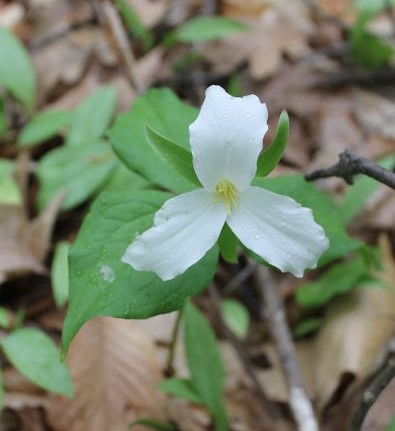
For generations of rural Western New Yorkers the white trillium was
one of the most recognizable wildflowers of the spring woods. The
brilliant plants would stand a foot tall and boast three magnificent
bridal-white petals atop three large leaves (hence “tri”-llium). It was
commonly found throughout forests and woodlots with rich soils.
I write in past tense because those days are long gone.
Younger WNYers – like Millennials – rarely have the chance to see
them in any quantity now and there’s a very good chance that the next
generation will never get a chance to experience this wonderful plant.
That’s because trilliums are under attack.
And, in this case, it’s not by man.
Nature is killing off the trillium at unprecedented rates.
When I was a youngster traipsing through our Niagara County woods in
the 1980s, the trilliums were incredibly abundant and put on quite a
show. Every spring during my childhood and early teen years, like
clockwork, the forest floor in one area would be blanketed by nearly an
acre of the showy flower.
Fast forward to 2023 and you would never know that happened. Now,
that section is devoid of trilliums and they are a very uncommon find in
the rest of the woods. Where once stood hundreds now stands the
periodic lone sentinel.
It’s not coincidental that the whitetail deer population has exploded
in that neck of the woods. Going back that same time, 35, 40 years ago,
I remember deer being an uncommon sight on the farm. Now, there are so
many that you don’t even look twice when they appear out of the brush.
It’s not uncommon to see multiple herds of 20 to 40 deer here in the
winter months.
Although plentiful farm crops are available seasonally, the deer have
to eat for the other seven months out of the year. So, they take to the
forests and overgraze the understory, eating every plant in sight. They
find the trilliums to be especially attractive as compared to other
plants, because the leaves and flowers are equally tender and
nutritious.
When they dine on trilliums they kill them. Many plants can survive
browsing, coming to bloom the next year thanks to healthy bulbs. The
trillium, though, has a weaker, shallower-running rootstalk, which needs
the leaves to make as much energy as possible and bring life. If those
leaves can’t take advantage of their short window of existence (3 weeks
of photosynthesis), the plant dies. And, by eating the succulent
flowers, the deer takes away the trillium’s ability to reproduce.
The deer kill trilliums at an amazing pace. A 1998 study that was
printed in a 2001 edition of the Journal of the Torrey Botanical Society
found that deer ate 26 percent of the trilliums in a measured lot.
Imagine such destruction continuing on an annual basis!
This overbrowsing has wiped vast out stands of trilliums, just like
ours at home, all across the northeast. Here in Allegany County, deer
have decreased the trillium numbers at a pace similar to that in Niagara
County. Now, stands of them, such as those seen roadside along Route 19
near Belmont (where the car traffic probably keeps deer browsing to a
minimum) catch the eyes of us older folk, taking us back in time to an
era that once was.
They aren’t the only flower under attack, either.
A major fear of we amateur naturalists and the professionals (the
likes of the New York State Department of Environmental Conservation) is
that deer are forever altering the forests, killing not only trilliums,
but countless other wildflowers. It is believed that ginseng (another
plant beloved by deer) will become extinct in the northeast by time this
century closes, solely because of deer and not by ginseng profiteers.
The late Gerry Rising – who was a nature columnist with the Buffalo News
– thought, as I do, that deer have harmed orchid populations in
Allegany County at a scale worse than the deforestation of the 1800s.
The DEC has obsessed a great deal about overgrazing by whitetail deer
and officials within the organization believe that were deer to be
fully removed from WNY forests most woodlands wouldn’t be able to return
to their natural pre-deer- boom state, even after 20 years of regrowth.
Many of our wildflowers are never coming back.
So, appreciate trilliums while you can. One day, and maybe soon, you will see the last one that you ever will.
The DEC currently lists the white trillium as “exploitably
vulnerable”, meaning it is attractive enough to be picked or
transplanted and people will do that and kill it. I’ll bet, though, that
within the next 10 to 15 years, the plant’s status will be downgraded
to “threatened”, maybe even “endangered”.
It’s that dicey of a situation we are dealing with. We have a deer problem. And, it’s a big one.
It was a savvy and accurate PR move when, in 2020, Allegany County
adopted the moniker “Western NY Wilds” for branding purposes. It
perfectly speaks to the essence of what keeps people here and brings
tourists in.
With it, though, comes some responsibility.
How do we not lose our identity?
But more so, how do we keep the Western NY Wilds wild?
That’s where the Western New York Land Conservancy comes in.
The Land Conservancy (www.wnylc.org)
is a regional non-profit land trust that permanently protects more than
7,500 acres of private land with significant conservation value in
Western New York. It has hopes of adding more acreage and has Allegany
County in its sights, specifically to protect the Black Creek watershed
and keep it wild.
The importance of the Black Creek watershed
Black Creek has its headwaters in Keeney Swamp, a 3,100-acre chunk of
state land that’s so special it’s the only place in Allegany County –
and one of only a handful of locations in all of Western New York —
where balsam fir occurs naturally. That pristine water flows out of the
swamp and across multiple tracts of private land, ultimately reaching
Angelica Creek, which then feeds the Genesee River.
Black Creek is home to trout (stocked and wild), other species of
fish like darters, a plethora of salamanders, and birds like
waterthrushes…all of which could be harmed if water quality tanked.
This watershed is being targeted not only to afford protection to the
Genesee River and its natural inhabitants, but also to the people
within the Black Creek watershed that rely on its water — Black Creek,
Angelica Creek, and their various feeders, springs, and wells supply
drinking water to the village of Angelica and numerous other homes in
the area.
Sales vs. easements
To ensure the utmost water quality for the consumer of that water —
plant, animal, and Man alike – the Land Conservancy wants to enter into
protective agreements with landowners within the watershed, specifically
those whose land borders the creeks or whose land has smaller
tributaries and other runoffs (such as intermittent streams) that fill
Black Creek year-round or seasonally. They are especially interested in
larger parcels (50 acres or more) in the towns of Allen, Angelica,
Birdsall, Grove, and West Almond.
This can be achieved one of two ways: Transfer of property or a conservation easement.
In the first case, the property owner would sell or donate land to
the Conservancy (as a non-profit, the Land Conservancy can buy the land
only at market value). They would then permanently protect the land as a
nature preserve.
Perhaps the preferred means for all parties is to protect the wilds
with an easement. Through a donation or sale of the easement the current
landowner retains ownership of the land but forgoes development rights
of that parcel (as does the next owner). That land, in perpetuity, is
intended to stay as is, or close to it.
There is some flexibility afforded in easements for working forests
(as long as they are sustainably logged, provide riparian protection,
and have a plan developed by a certified forester). But, changing the
landscape for things like housing developments, fossil fuel extraction,
commercial enterprises, and industrial-scale solar energy are all
frowned upon.
It should be noted that with the Black Creek project the Land
Conservancy sees farmland as being equally attractive to forests when it
comes to easements because it serves the ultimate goal of maintaining
or improving the quality of the water. Farmers can still farm. They’ll
just have to comply with some minor protections such as riparian buffers
for 300 feet around the creek.
If selling development rights, they are generally purchased by the
Land Conservancy for the difference in market value of the land with
development rights and without.
Engaging the Conservancy
If your property fits the bill for the Black Creek project, make it a
point to reach out the Western New York Land Conservancy very soon. You
want your foot in the door before the funds are used up.
The Land Conservancy has $2,000,000 set aside for this specific
endeavor in hopes of covering as much land as possible. These funds came
to be from a Watershed Quality Improvement Program grant from the New
York State Department of Environmental Conservation whose focus in on
sourced water — the Black Creek watershed is just that for Angelica.
Your contact at the Land Conservancy is Marcus Rosten at 716.687.1225 ext. 118. His email address is mrosten@wnylc.org
If you enter into deeper conversations with the Land Conservancy, be
sure to consult with your tax planner or lawyer, something Marcus will
also encourage you to do.
This is just the beginning for the Land Conservancy
The Western New York Land Conservancy has been doing their thing
throughout WNY for years, but this is their most high-profile endeavor
to date in Allegany County.
It won’t be their last.
I recently had a long chat at the coffee shop with Marcus whom you
might recognize for his infectious joy for nature when he appeared on Nature when the primetime PBS mainstay shined the spotlight on Niagara Falls last year.
We spoke at length about the Western New York Wildway, an ambitious
and vital vision the Land Conservancy has. It’s a landscape-scale
conservation initiative to protect and connect the largest tracts of
wildlife habitat in the 8 counties of Western New York, many acres of
the prime forestland can be found in Allegany County. The WNY Wildway
will allow plants and animals to roam across the land as they once did,
expand their ranges, and ensure their survival.
The WNY Wildway will protect the Western NY Wilds forever
I will note that the Western New York Wildway and the Western NY
Wilds, though sounding similar, are two entirely different, yet
complimentary things. The WNY Wildway is the Land Conservancy’s plan
which will protect many areas in the region…among them the Western NY
Wilds which is what Allegany County’s tourism office brands as the
county and everything within it. They are unrelated entities, unrelated
ideas, but one does protect the other.
I’m excited about what the future holds for the Western NY Wilds as
the Land Conservancy gets more involved with the various nuances of
nature in this county. It’s Black Creek today. It could be our “high
peaks” region tomorrow.
For landowners who, like me, see themselves as stewards of the natural world, this may be the thing we’ve been waiting for.
I’ve often pondered the future of my forestland in Alma.
When I pass, will my kids see their role in preserving the forest in
the same way that my father and I are? I would hope so, but you never
know. By signing an easement, I’d be able to define land usage from the
grave.
Or, what if property taxes become so exorbitant that I one day have
to sell? A buyer might talk a good game, but how would I know they
wouldn’t clear cut the forest or sell it off as numerous camps? That
wouldn’t happen with a conservation easement in place.
Luckily, the Western New York Land Conservancy has various ways –
that will outlive all of us — to ensure the sanctity of forests, farms,
and other greenspaces, keeping the Western NY Wilds wild for future
generations and for the living things we share this world with.
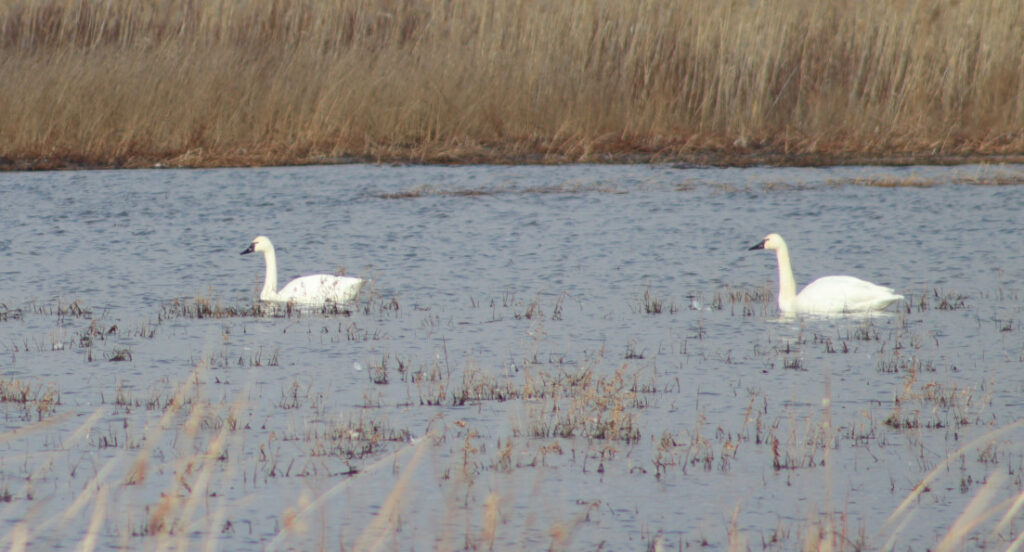
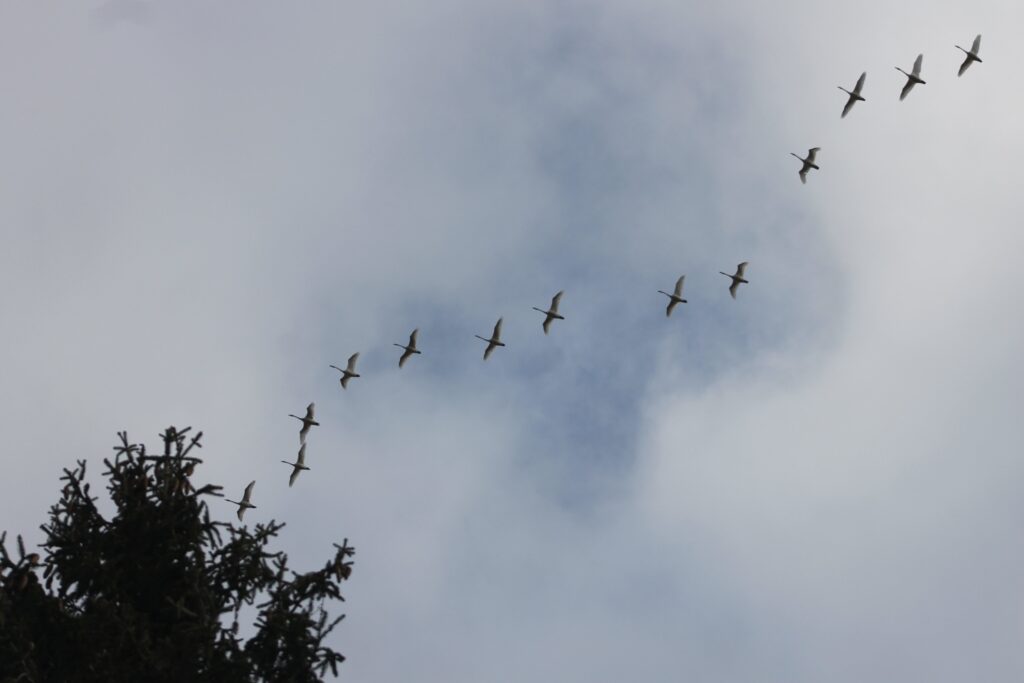
Keep your eyes to the skies. Recently, one of my favorite signs of
spring – and certainly one of the most beautiful – have been migrating
through the region. Tundra swans are making their journey to the far
north and are gracing us with their angelic appearance and interesting
calls.
For the most part, tundra swans spend their winters along the
mid-Atlantic and mid-Pacific coasts of the United States. During tame el
Nino winters, like the one we had, quite a few stragglers will spend
the cold months WNY — especially at the Iroquois Wildlife Refuge — where
they take advantage of the open waters.
These swans are leaving their wintering grounds and just now
beginning their northward treks. I’ve always found that their migration
through Western New York hits its peak between March 12th and March 15th of every year, while smaller flocks can be seen as late as the first week of April.
Their numbers are nothing like those of the Canada geese or various
ducks that pass through the area. Overall, their northern breeding
populations is estimated at 280,000 birds. I would consider tundra swans
to be uncommon migrants around here – I might be lucky to see maybe a
half dozen each pass overhead every March. That’s what makes seeing them
so special.
You can’t mistake them when you see them. They have large white
bodies and very long necks (which allows you to tell them apart from
snow geese, which are also white). They have a mammoth wingspan of 5 to 7
feet and they’re big…a healthy adult bird can weigh more than 20
pounds.
You can also tell them apart from other migrating waterfowl by their
high flight. You will notice they fly much higher than Canada geese.
Migrating geese fly at altitudes of 2,000 to 9,000 feet. Swans fly at
heights of 9,000 to 26,000 feet!
They have an interesting call that travels a very long distance – and
which will alert you to an incoming flock. It’s best compared to a
clarinet-like hoot or maybe even a dog bark. I absolutely love their
sound as it means spring is here. Whenever I hear them, I stop what I’m
doing and soak it all in.
Tundra swans were once commonly known as whistling swans because of
the whistling sound created by their wings in flight, a sound so
pronounced you can hear it even if they are 100 feet above your head.
Swans will stop to feed in open fields while here and they spend their evenings and nights sleeping on ponds and lakes.
Tundra swans are with us for only a few weeks. Savor their brief
visits and their stark beauty – they’re telling us spring is here.
In what might appear to be an homage to settlements of the Old West,
about 10 years ago I began the habit of putting cow skulls or deer
skulls near my back porch, the main entrance to my home. That has no
doubt caught the attention of visitors, especially those who don’t know
me well.
But, there is a method to my madness.
Regular visitors will notice that every one of those skulls has “shrunk” down to nothing.
They weren’t destroyed by the sun’s ultraviolet radiation. They
weren’t eaten by carrion beetles. Nor were they worn away by sidewalk
salt.
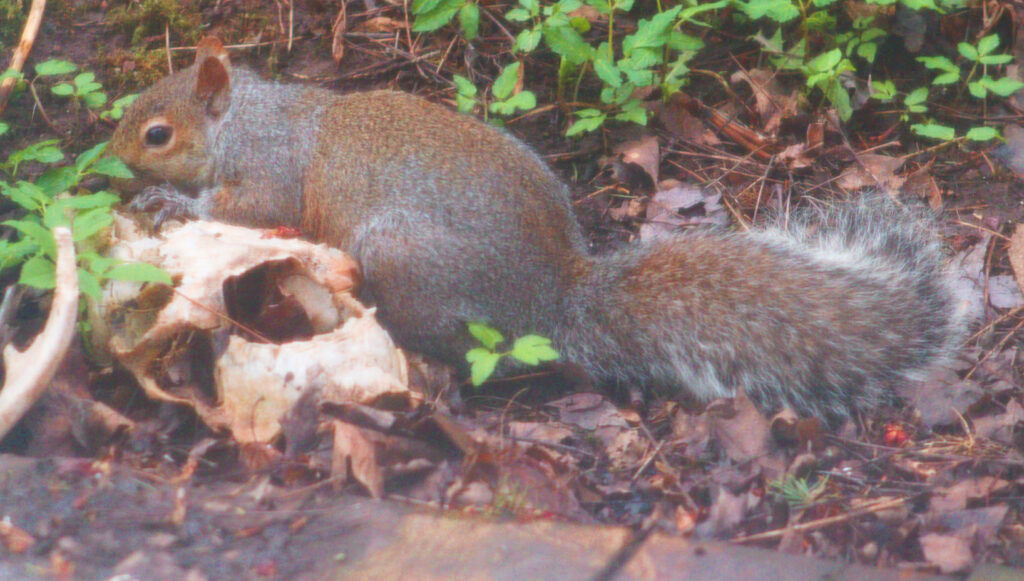
Instead, each of those skulls was consumed by grey squirrels.
Most people think of squirrels as cute, docile little animals that
eat nothing but seeds and nuts. That stereotype can quickly change when
they see the bug-eyed creatures gnawing away on bone. There’s something
strange about it.
Adding to that sight is the unforgettable sound. I’m sure you’ve
heard squirrels chewing on walnut shells in the fall. That sound, loud
in itself, is nothing like tooth on bone, especially on a hollow,
resonant skull. That fingernails-on-chalkboard sound can be heard from
almost one hundred feet away.
They aren’t doing it for kicks. They are doing it for survival, which is why I keep skulls laying around.
There is twofold benefit for squirrels consuming skulls.
First off, they must do this to stave off metabolic bone disease. MBD
is a common ailment for squirrels in captivity and squirrels that live
in yards away from forests (such as those in a village or in farm
country, where I live). What happens is they consume birdseed, walnuts,
butternuts, hickory, and even corn from adjacent farm fields – foods
high in phosphorous and low in calcium. That creates a chemical
imbalance whereby the squirrel is overcome with lethargy and develops
fractured bones.
Prior to putting skulls out, I would occasionally see squirrels
suffering from strange seizures or losing use of their back legs. Those
are both telltale signs of deep MBD. I haven’t seen one sickly squirrels
since the skulls were made available for them. They get the calcium
they need from eating the skull, so the sickness that previously
affected squirrels in my yard is a thing of the past.
Bone disease doesn’t normally happen to forest-dwelling squirrels as
they get calcium from carcasses, bones, and shed deer antlers found
throughout the forest (things you normally don’t have laying on your
lawn). It happens a lot to pet squirrels, which is why experienced
squirrel owners feed their pets calcium powder or bones that would
normally be given to dogs.
Another reason that squirrels chew on bone is to keep their teeth in
check. I’m sure you’ve heard that if beavers don’t keep gnawing wood,
their teeth will grow too long, piercing their lower lips or extending
beyond their lower jaw, making it impossible to eat, thus starving from
their lack of good dental care.
The same holds true for squirrels. This is called malocclusion and,
as with the beaver, it could cause the slow death of a squirrel. By
gnawing on bone material, they can keep their teeth short and useful.
This is why you might also see them chewing on the stone foundation of
your home.
Having access to bones is crucial for the health, even life, of
squirrels. So, if you have a family of them in your yard and you
appreciate their cuteness, companionship, and silly antics, do them a
big favor and put some bones out for them. You don’t have to go
overboard in a frightening manner like I do with animal skulls, but if
you can get access to some leg bones or soup bones it would go a long
ways in ensuring their well-being.